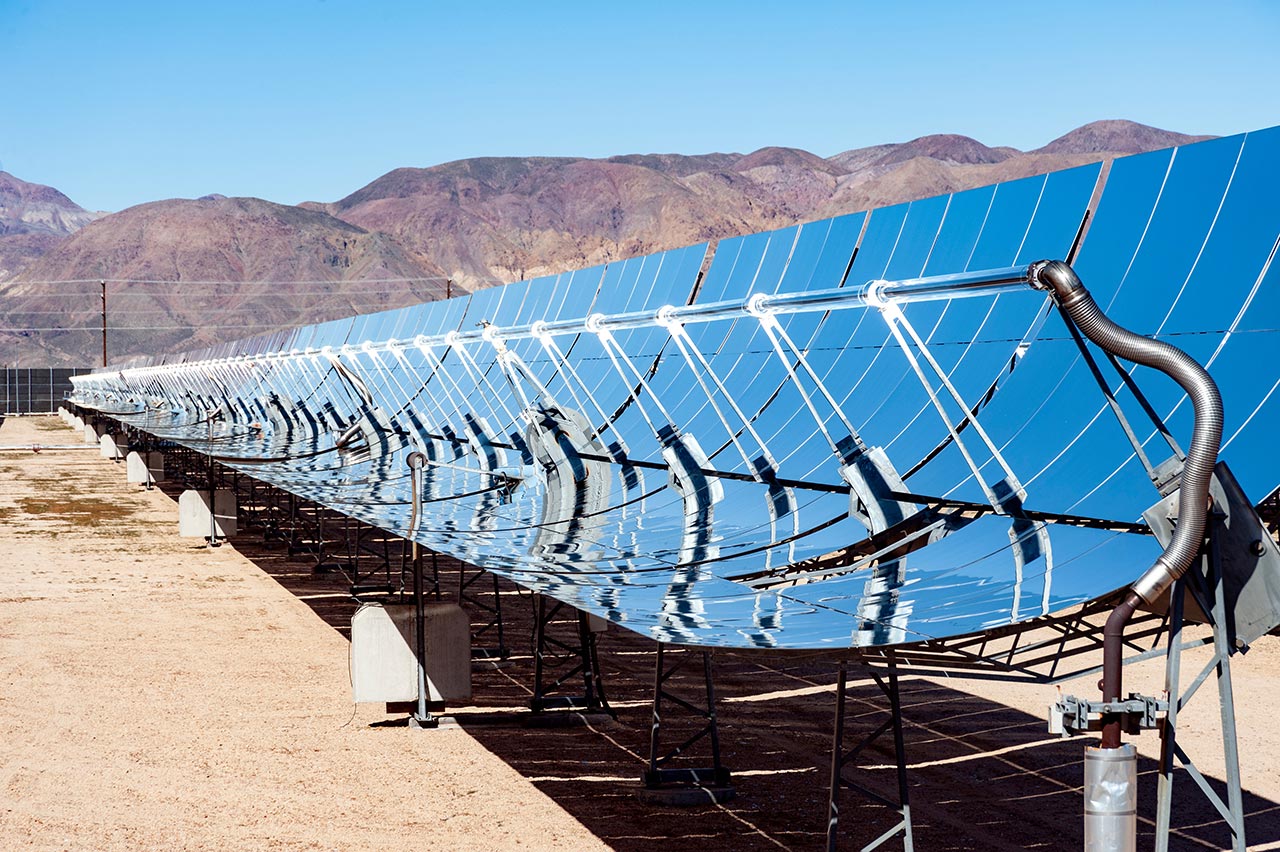
For any renewable energy asset — a solar thermal field, a wind farm, a PV plant — the return on the original investment depends on one thing above all: how much of the available resource the plant actually converts into delivered energy over its life. That figure is governed by reliability and availability, and both are engineered outcomes, not matters of luck.
An asset that suffers frequent forced outages, slow restarts, and recurring faults will under-deliver even in a perfect resource. One that is engineered and maintained for reliability will quietly out-produce it year after year. The difference lies in a handful of disciplines that any operator can adopt.
Distinguish reliability from availability
The two terms are often used interchangeably, but they describe different things. Reliability is how seldom equipment fails; availability is how much of the productive time the plant is actually ready to operate. A plant can be reliable but poorly available — if repairs are slow — and it can paper over poor reliability with fast repairs, at a high running cost.
Improving the asset means working both sides: reducing how often things fail, and shrinking the time lost when they do. Measuring them separately shows which side is the bigger opportunity.
Find and fix root causes
The most common reliability trap is fixing symptoms. A tripped drive is reset, a leaking seal is replaced, a fault is cleared — and the same failure returns weeks later because the underlying cause was never addressed. Recurring failures are expensive precisely because each recurrence costs another outage.
Root-cause analysis breaks that cycle. For any significant or repeated failure, the discipline is to ask not just what failed, but why — and to keep asking until the answer points to a cause you can actually eliminate, whether that is a design weakness, a maintenance gap, an operating practice, or an environmental factor.
- Capture the failure accurately — conditions, symptoms, and what was done to recover.
- Trace the causal chain past the immediate symptom to the underlying cause.
- Implement a corrective action that removes that cause, not just the symptom.
- Verify over time that the failure mode does not return.
Use condition monitoring where it pays
Much rotating and tracking equipment gives warning before it fails. Vibration, temperature, current draw, and performance drift all change as a bearing wears, a drive strains, or a pump cavitates. Condition monitoring turns those signals into advance notice, converting an unplanned forced outage into a planned intervention at a convenient time.
A failure you see coming is a maintenance task. The same failure unseen is an outage.
Condition monitoring does not need to cover everything to be worthwhile. Focused on the critical, hard-to-replace, or historically troublesome equipment, it delivers most of the benefit for a fraction of the instrumentation cost.
Design maintainability in
Reliability is not only an operations problem; much of it is decided by how easy the plant is to work on. Access to equipment, availability of drawings and procedures, the quality of isolation points, and the presence of the right spares all determine how quickly a fault can be diagnosed and cleared. Two plants with identical equipment can have very different availability purely because one is far easier to maintain.
Where maintainability was not designed in, it can often be improved retrospectively — better access, clearer documentation, pre-staged spares, and standardised procedures all shorten repair times without touching the equipment itself.
Close the loop with continuous improvement
The operators who achieve high availability treat it as a moving target. Every outage is data. A structured review of what failed, how long recovery took, and what would have prevented or shortened it feeds directly back into the maintenance programme, the spares holding, and sometimes the plant design itself.
Over time this compounds. Each solved root cause is a failure mode that never returns; each shortened repair is availability recovered permanently. That is the essence of reliability engineering — not a single intervention, but a discipline that steadily raises the floor on what the asset can deliver.
Pack N Move Renewable Energy works with operators to raise the availability and reliability of renewable energy plants through operation and maintenance support, engineering assessment, and the continuous-improvement approach that keeps performance climbing over the life of the asset.
All articles.jpeg)